Skip to content

Brechin City 1907/08

£12.99

The Men Who Made Brechin City: 1907–08

In the early years of the twentieth century, Scottish football was already developing the structures that would define it for generations: leagues, formalised clubs, regular fixtures, and growing public interest. Yet for all the attention paid to the great urban institutions, it was clubs like Brechin City FC that quietly determined whether the game would truly take root beyond the major cities. The 1907–08 season, captured in a remarkable team photograph, represents one of the most important formative moments in the club’s history.

Founded only in 1906, Brechin City was still finding its footing. Survival mattered as much as success. The club was establishing routines, developing expectations, and convincing both players and supporters that senior football could endure in a small Angus town. The photograph from the 1907–08 season is therefore not merely a record of a football team; it is visual evidence of consolidation.

A young club finding its shape

By 1907–08, Brechin City had moved beyond its experimental phase. Fixtures were regular, organisation was improving, and the club was beginning to look and behave like a permanent institution rather than a hopeful local venture. This transition is visible in the image itself.

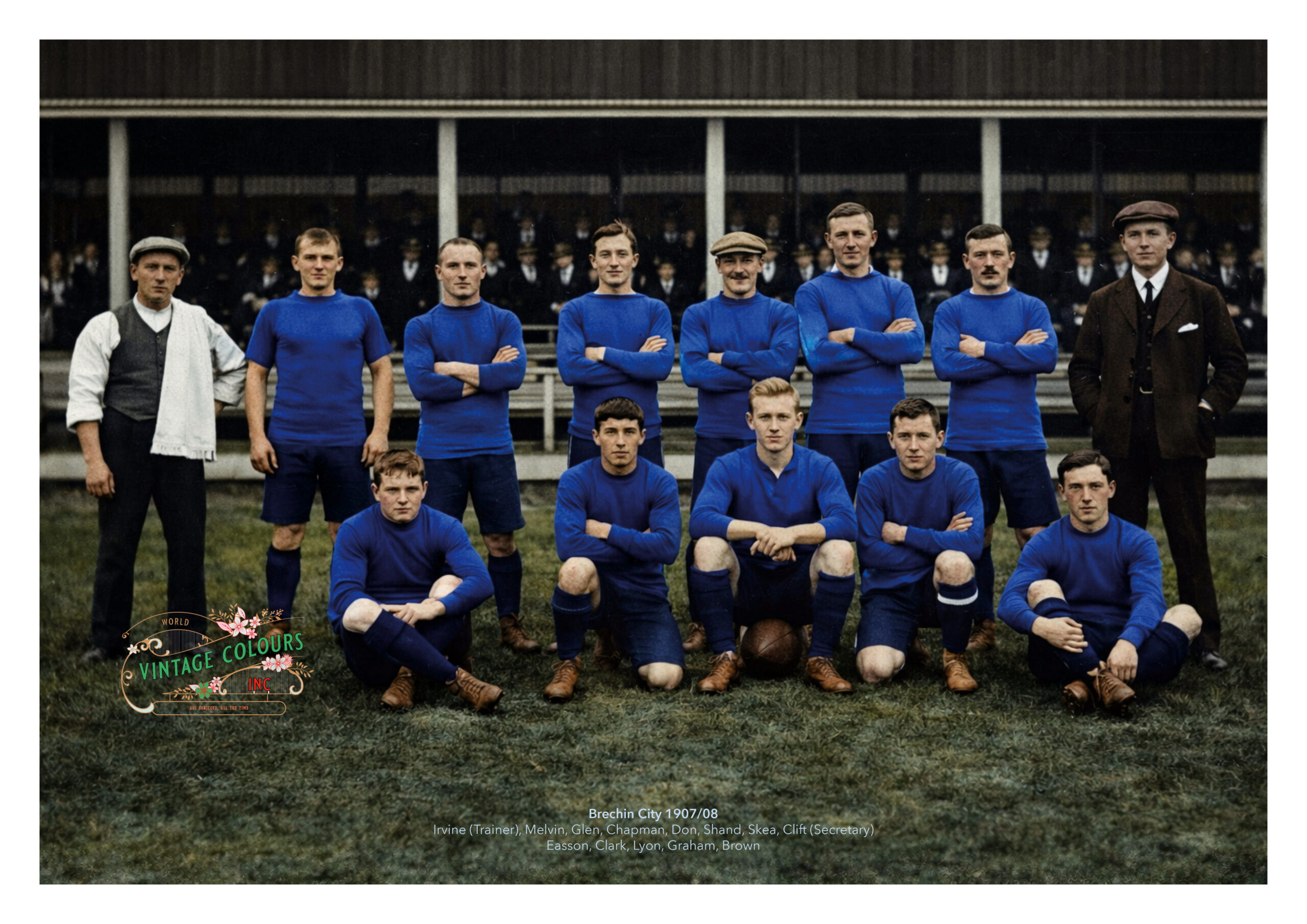
The team is formally posed, disciplined in stance and dress, and framed by a covered stand with spectators behind — a sign that football at Brechin was already a communal event. This was no casual gathering of enthusiasts. It was a recognised first team, presented for the record. The list of names beneath the image tells its own story:

Irvine (Trainer), Melvin, Glen, Chapman, Don, Shand, Skea, Clift (Secretary),
Easson, Clark, Lyon, Graham, Brown.

These are not the names of national stars. They are the names of working footballers and organisers — the type upon whom the early Scottish game depended.

Football before fame

To understand this team properly, it is important to recognise what “success” meant in 1907–08. For a provincial club like Brechin City, the realistic ambitions were stability, competitiveness, and continuity. Entry to higher leagues was restricted. Scouting favoured the Central Belt. Financial margins were narrow. Most players combined football with full-time employment. Careers were short, injuries frequent, and movement between clubs informal. In that context, simply holding down a first-team place over multiple seasons represented achievement.

Several players in this photograph — Melvin, Glen, Shand, Skea, and Easson in particular — appear repeatedly in Brechin line-ups of the period. That alone marks them as trusted and reliable footballers. They were the backbone of the side: men who trained consistently, turned out week after week, and gave the club credibility. None went on to international honours. None became household names. But collectively they did something far more important for Brechin City: they made the club work.

The unseen importance of roles off the pitch

One of the most revealing aspects of the image is the explicit identification of Irvine as Trainer and Clift as Secretary. In the early twentieth century, these roles were often more influential than the modern concept of a manager.

The trainer was responsible not just for fitness, but for discipline, preparation, and often tactical instruction. Many trainers were former professionals whose knowledge shaped young clubs profoundly. Irvine’s presence signals that Brechin City understood the need for structured preparation, even at this early stage. The secretary, meanwhile, was the administrative heart of the club: arranging fixtures, registering players, handling correspondence, and negotiating league matters. Clift’s inclusion in the photograph underlines how central administration already was to Brechin City’s survival.

Together, these roles indicate a club thinking beyond the immediate matchday — planning for longevity.

A team shaped by its time

The players’ appearance reflects the era: plain blue jerseys, dark shorts, heavy boots. There is no embellishment, no individuality beyond posture and expression. This was football before commercial identity, before shirt sponsorships or celebrity. Yet the uniformity also speaks to collective purpose. Brechin City in 1907–08 was not built around a star player or tactical innovator. It was built around shared effort.

The men in the photograph represent different paths within the game. Some would drift back into local football or retirement. Others would move quietly between clubs. A few may have served in the armed forces or seen their football lives interrupted by the First World War. Records thin as the decade progresses — a reminder of how fragile early football careers were.

Why this team matters

The importance of the 1907–08 side lies not in trophies or league position, but in continuity. This was the generation that demonstrated Brechin City could endure. They gave the club a rhythm: seasons followed seasons, fixtures followed fixtures. Supporters could expect football to be there. Without teams like this, Scottish football’s pyramid would never have stabilised. The game did not grow solely because of its giants; it grew because small-town clubs persisted through lean years, fielded honest teams, and embedded football in local life.

Brechin City’s later achievements — league membership, famous cup ties, and a lasting place in the Scottish game — rest on foundations laid by men such as those pictured here.

A photograph of builders, not heroes

Seen today, the 1907–08 photograph carries a quiet authority. These men were not playing to be remembered. They were playing because football had become part of who they were and part of what Brechin was becoming. They did not shape history by winning championships. They shaped it by turning up, organising themselves, and keeping a young club alive.

In that sense, this image captures something fundamental about Brechin City Football Club: a tradition of resilience, community, and understated commitment that would define the club for generations to come.

SKU: BrechinCity190708 Categories: , ,

The print is A3 size (42cm x 29.7cm and has a white border around it for framing purposes).

This print has been produced to archival standards on premium 300gsm fine-art paper, selected for its depth of tone, texture, and long-term durability. It is suitable for professional framing and permanent display. Each image is carefully restored and prepared with historical restraint, with no alteration or re-imagining of original facial features. Any digital watermarking visible online is not present on the physical print you receive. The print is available in three sizes: A3, A4, and A5.

Every print forms part of a curated, limited production run available exclusively from this collection. Customers are charged a single postage cost regardless of the number or size of prints purchased. These prints are not simply wall art, but tangible pieces of football history, created for collectors who value authenticity, craftsmanship, and the preservation of the game’s heritage.

Any issues please contact me at paul@worldvintagecolours.com by clicking the link and I will get back to you ASAP.

Reviews

There are no reviews yet.

Be the first to review “Brechin City 1907/08”

Your email address will not be published. Required fields are marked *