Skip to content

The Goldstone Ground 1914 – Home To Brighton & Hove Albion

£12.99

Goldstone Ground, 1914

The early home of Brighton & Hove Albion

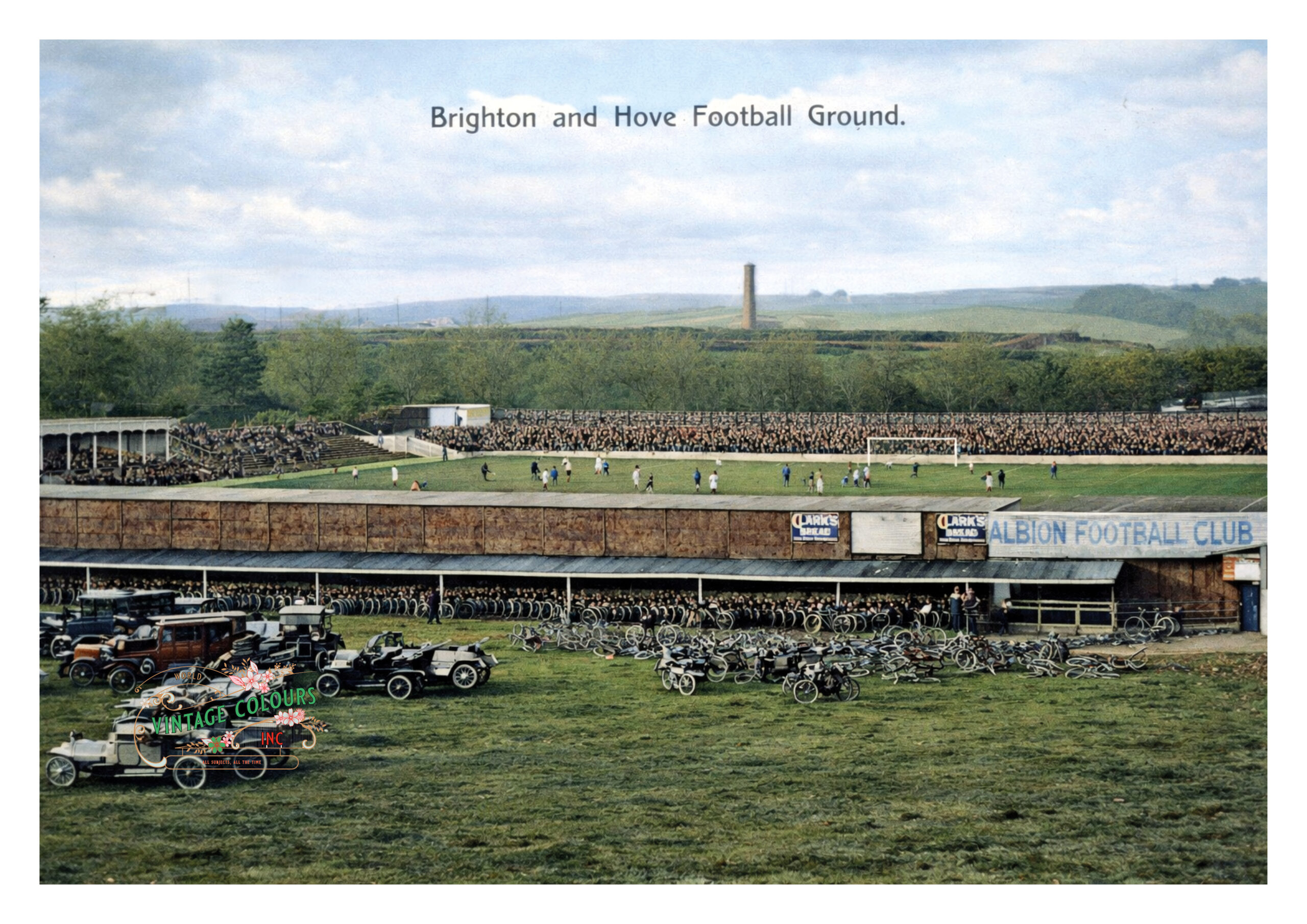
This exceptional colourised photograph captures the Goldstone Ground in 1914, at the height of its importance as the home of Brighton & Hove Albion and on the eve of a momentous interruption to English football history.

Opened in 1902, the Goldstone Ground served as Albion’s home for nearly a century and was central to the club’s emergence from regional obscurity to national relevance. By 1914, Brighton & Hove Albion were firmly established as one of the strongest clubs outside the Football League, competing in the Southern League, which at that time rivalled the Football League in quality and prestige.

A ground at full maturity

The scene depicted here shows the Goldstone Ground as a fully functioning Edwardian football venue. The covered stand dominates the foreground, packed with spectators, while large uncovered banks surround the pitch, illustrating the scale of crowds football was already attracting before the First World War.

The pitch itself is alive with activity, a match in progress, while the surrounding landscape stretches into open countryside — a reminder that Brighton, though growing rapidly as a seaside resort, was still on the edge of rural Sussex. The distant chimney and rolling hills contrast strikingly with the density of the crowd inside the ground.

Below the stand, rows of bicycles and early motor cars are parked tightly together. This detail is especially evocative: it captures the changing nature of matchday travel in the Edwardian era, when spectators increasingly arrived from surrounding towns and villages, drawn by the growing popularity of league football.

Brighton & Hove Albion before the War

In 1914, Brighton & Hove Albion were among the most respected clubs in the Southern League. The club had already won the FA Charity Shield in 1910, defeating Aston Villa, a result that announced Brighton’s credentials on a national stage.

The Goldstone Ground was integral to that success. Its capacity, atmosphere, and facilities gave Albion an advantage over many rivals, and crowds regularly ran into the tens of thousands. Football at the Goldstone was not a novelty; it was a major social event in the town’s calendar.

This image shows a club and a ground at their peak just before football — and everyday life — would be dramatically reshaped by the outbreak of the First World War later that year.

Why this image matters

Few photographs capture English football so completely in transition. This 1914 view shows:

  • a mature Edwardian football ground

  • organised mass spectatorship

  • early commercial signage

  • the coexistence of bicycles, cars, and horse-era infrastructure

  • football embedded firmly in local culture

Within months of this photograph being taken, league football would be suspended, players would enlist, and crowds would disperse. Some of the men visible here — players and supporters alike — would never return.

The Goldstone Ground’s legacy

The Goldstone Ground would remain Brighton & Hove Albion’s home until 1997, witnessing promotion, relegation, cup runs, and decades of changing football culture. Its eventual demolition marked the end of one of English football’s longest-serving stadiums.

This image therefore represents not only a moment in Brighton’s history, but a broader chapter in the story of English football — a sport poised between its Victorian origins and its modern future.

A rare visual record

As a colourised restoration, this image offers a rare opportunity to see the Goldstone Ground as contemporaries experienced it: the green of the pitch, the press of the crowd, the Sussex landscape beyond the terraces.

It is a powerful reminder that football grounds were once central civic spaces — places where towns gathered, identities were forged, and history quietly unfolded.

SKU: GoldstoneGround1914 Categories: , ,

The print is A3 size (42cm x 29.7cm and has a white border around it for framing purposes).

This print has been produced to archival standards on premium 300gsm fine-art paper, selected for its depth of tone, texture, and long-term durability. It is suitable for professional framing and permanent display. Each image is carefully restored and prepared with historical restraint, with no alteration or re-imagining of original facial features. Any digital watermarking visible online is not present on the physical print you receive. The print is available in three sizes: A3, A4, and A5.

Every print forms part of a curated, limited production run available exclusively from this collection. Customers are charged a single postage cost regardless of the number or size of prints purchased. These prints are not simply wall art, but tangible pieces of football history, created for collectors who value authenticity, craftsmanship, and the preservation of the game’s heritage.

Any issues please contact me at paul@worldvintagecolours.com by clicking the link and I will get back to you ASAP.
Reviews

There are no reviews yet.

Be the first to review “The Goldstone Ground 1914 – Home To Brighton & Hove Albion”

Your email address will not be published. Required fields are marked *